
Cavernous Shoal
OPEN ROOM, Residency
- Residency: Sep 19-Jun 16
- Opening Hours: M-T | 12-6pm
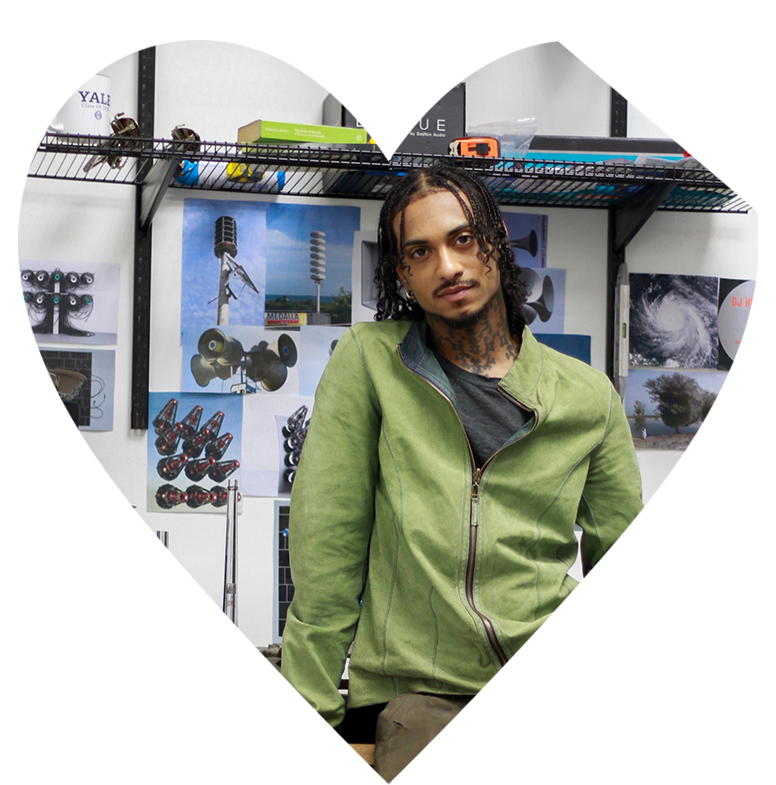
Jesús Hilario-Reyes, an anti-disciplinary artist working at the intersections of sonic performance, land installation, and expanded cinema, redesigns our lobby and community space OPEN ROOM as our season-long resident. Entitled Cavernous Shoal, the space includes a bespoke sound system and a sculpture composed of mangrove roots to assemble a temporary ecology: one that stabilizes without fixing, gathers without enclosing, and produces forms of belonging that emerge through movement rather than permanence.
This installation draws inspiration from the rhizomatic nature of DJ culture and shorelines shaped between land and sea, understanding the dancefloor in Black diasporic club culture as sites of perpetual transformation where belonging is secured through relation rather than geography. Shoals are shallow areas where ridges of land impede the movements of sailing vessels. The location of shoals erode and change over time, in a fluctuating boundary between land and sea, always emerging as places of contact and becoming.
OPEN ROOM is located on the 4th floor with elevator access, gender-neutral restrooms, free WiFi access, and open to the public. OPEN ROOM is a publicly accessible space used by members of our community for readings, meetings, book launches, hangouts, coworking, performances, and more. Each season, we invite an artist or collective in residence to re-envision the space and think about creating a gathering place for community and expanded programming. Within this year-long OPEN ROOM residency and installation, Hilario-Reyes will host open decks, performances, conversations, workshops, screenings and experimental sound activations. We invite you to hang out, gather, listen, and engage with the space.
Schedule of Programming:
Cavernous Shoal opens with a live performance from Ibrahima Mbaye, entitled LIVING ROOM.
LIVING ROOM transforms Jesús Hilario-Reyes’ installation into a living audio environment and playable instrument for live performance. Ibrahima arranges herself as vocalist among surfaces rigged to produce sound and samples when struck. She applies electroacoustic methods with spiritual animist logic, charging the room with sonic “soul stuff”, and moving through the space rendering imaginary friends to aid the composition. Here, Ibrahima satisfies her longing to commune with objects and space itself.
Ibrahima Mbaye is a sound artist and experimental vocalist based in New York City. Her live practice currently involves vocal synthesis, multi-instrumental play, and sound installation. She molds and refashions acoustic forms, projecting her internal, gendered logic of transition onto objects, spaces, instruments, and voice.
Ibrahima also DJs under the alias Doula. She is known for her unpredictable range and sound collage approach, crafting intense, psychedelic sets that disregard expectations of genre, functionality, tempo, cadence, and respectability.
Gasoline Girl draws upon the technology of the CDJ, an instrument that marks and also ultimately unsettles how one arrives at time. For Yesenia Rojas, it can also play with the limits of reality by cutting, looping, and slicing through it. Animated by the chaos of the elemental world, specifically oil as a dialectical engine that traces and touches bodies and social systems, this work casts the compression of organic and mineral life onto the inherited tensions between sound and image. Deploying digital aesthetics, multi-deck experiments, and live video editing, this performance wrestles with the raw physicality of what it means to generate energy against the pulse and scratch of time.
Manufacturing Cunt: A Conversation about the Influence of Nightlife in the Latinx and Fashion Community with Raúl Lopez (founder and lead designer of LUAR), Jesús Hilario-Reyes, and Carina del Valle Schorske
This program is presented as part of Remesas y Sobremesa, an ongoing signature series co-presented with The Clemente Soto Velez Cultural Center as part of their multiyear HISTORIAS initiative. Remesas y Sobremesa invites the community to gather around the table, where the warmth of food and shared meals meets thoughtful dialogue. This edition will launch the third episode of Dance, Memory, and the Sonic Commons, a three-part radio series commissioned from Montez Press Radio for HISTORIAS, featuring Jesús Hilario-Reyes and Carina del Valle Schorske.
Jesús Hilario-Reyes: “The sound system functions as a vessel for site—or more precisely, for site-making. Within club culture and dance music, it is the sound system that constitutes the site itself. The dance floor is only the membrane upon which the traces of that encounter accumulate. In this sense, activations are always occurring, wherever people gather. This is especially true within diasporic contexts, where belonging is not secured by geography but produced through relation. Regardless of location or territorial coordinates, one comes to recognize a sense of place through the collective presence of others.
The mangrove becomes its central figure because it constructs threshold worlds between tropical coastlines and the open ocean. Its exposed root systems weave into vast rhizomatic networks that become ecosystems in their own right. Within these porous boundaries, sediment is held in place, storm surges are softened, and countless species find shelter and the conditions necessary for growth. The mangrove suggests a formal understanding of site as both organism and technology of holding. It works through the entanglement of the imported and the native, the synthetic and the organic, the violent and the sustaining. I find a poetic refraction of this logic in the rhizomatic nature of DJ culture and in the strange, collective hold of the night.
In Pedagogies of Crossing by Jacqui M. Alexander offers an insightful proposition for thinking about our relationship to site. She complicates the notion of arrival, writing that “people in exile/diaspora have grown up metabolizing exile; feeding on its main by-products, alienation and separation.” She asks us to consider what it means to be “African American and exiled on the spot where one is born. To be Caribbean and exiled on foreign soil producing a longing so deep that the sight of neglect is reminiscent of beauty.” Here, Alexander underscores the ontological and phenomenological conditions of exile and dispossession as multigenerational inheritances rather than singular events. This distinction leads me to a question that runs throughout these offerings: if dislocation is fundamental to the way one arrives at a site, can there be a reparative gesture in its continual relocation?”